
My Arteriors story starts when the brand opened its first showroom in London’s Chelsea Harbour Design Centre. Visiting in my capacity as a magazine editor, I was swiftly cornered by an enthusiastic PR keen to know my thoughts. Never one to hold back, I said that I found the showroom too full, too bright and too busily styled for my tastes. Cue crest fallen expression.
However, a few months later I was invited to walk my talk and be the first UK participant in the brands’ highly successful ‘Designer Interpretations’ series. In the words of Arteriors’ Head of Marketing and Visual, Krista Stelling, it’s “an invitation to the most dynamic tastemakers around the globe to create a unique design installation”. A handing over of the showroom styling reins with the aim of “opening up the brand to a different point of view”. It was a brave and confident challenge from the brand that I was absolutely honoured to accept.

My moodboard of my Arteriors x Michelle Ogundehin ‘Designer Interpretations” at the brand’s London showroom in Chelsea Harbour Design Centre, September 2018

My edit of a selection of pieces from the Arteriors Home collection. Wall behind painted in ‘Marine Blue’ from The Little Greene Paint Company.
Who is Arteriors?
Founded in 1987 by Mark Moussa, Arteriors, headquartered in Dallas, started out as a small accessories company. Gradually Mark, who previously worked alongside his father in the family import business, added a few lights, then a couple of pieces of accent furniture. Fast forward to today and it’s a huge global enterprise releasing more than 500 new designs every year.
Mark describes his strategy as thinking like a fashion brand because as he introduces new pieces he also retires others enabling the stock to constantly evolve. As for his inspirations? “I look to create products with a visual push and pull by combining finishes, forms and fabrics in a way that is provocative and compelling yet still allows for personal interpretation. I love the yin and yang of artisan and luxe and embrace the notion that many of our pieces are art pieces, so to speak.”
And this is precisely what drew me to working with the brand. The mix of the raw and the refined combined with the clear influence of art, fashion and travel with a healthy dose of artisanal luxe. As Mark puts it, “The human touch and artisanal element is what makes each piece special and one-of-a-kind. It’s the signature that the artist puts on each of the products they produce.” It was a marvellous palette to play with, and a great team to collaborate with. I heartily, and authentically, endorse its wares!
Interview with Arteriors Home
What was the inspiration behind your curation?
I felt that many of the pieces were incredibly sculptural. Also very rich in form and texture, which made me think of Brancusi, especially his Parisian studio, which is still open to the public. Arteriors’ designs are also made from an extremely refined palette of materials — marble, wood, antiqued bronze, brass, polished nickel and iron. This made me think of the French architect/interior designer Joseph Dirand, whose work I really admire. I then combined these two references in my head. Threw in my love of off-beat symmetry and a preference for multiples — I believe pairs of pieces make for a happier space! And then overlaid it all with plenty of rich pattern and texture.
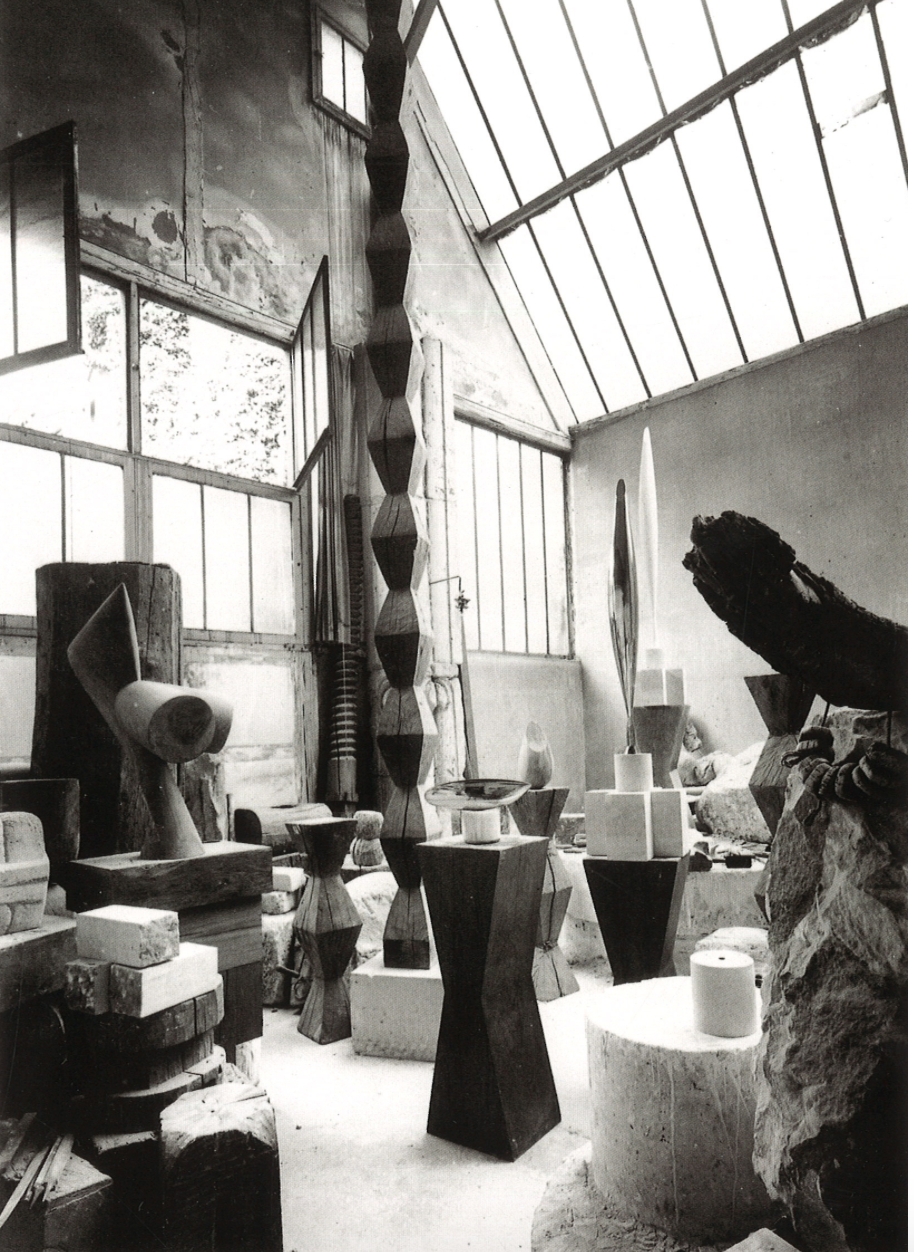
The Parisian atelier of the sculptor Brancusi.

The ‘Monsieur Bleu’ café in Paris designed by Joseph Dirand
The details…
Essentially, I always work up from the floor and furniture to create a solid base for any look. I centred my concept around the generous curves of the ‘Turner’ sofa which I re-upholstered in a sumptuous apple green ‘Adamo & Eva’ 100% cotton velvet from Dedar. I then took a lead from the fabulous ‘Jericho’ reclining chairs (which definitely have ‘Future Classic’ written all over them!). These are finished in teak with hand-woven jute seats and really epitomise what I’ve predicted as a move towards more humble materials being handled exquisitely in the home.
This sort of project is about dressing a space in a series of layers. The final touch? I added jewellery to the look in the form of some of the amazing lighting and accessories which Arteriors absolutely excels at.

Computer aided cut and paste mock ups for my installation. Olde School!
How does the space reflect your personal style?
The colours, mix of materials and touch-tastic textures are all very me. Plus, I absolutely love to add a little unexpected top note to any scheme. In this case a dash of Chinoiserie via the amazing ‘Lodi Garden’ print from Brunschwig & Fils which I had made up into a full drop pencil pleated curtain that drapes across the entire back wall.
And then the mix of fabrics I chose for the cushions were all about adding contrast and spice. ‘Say Goodbye Flora’ from Dedar; ‘Xian’ from Brunschwig & Fils; ‘Acid Palm’ and ‘Polka Dot Plush‘ in a wonderful mustard colour, both from Kravet. These soften the space, and mixing them all together created something really warm and inviting (see my moodboards below).

Moodboard of materials and colours: ‘Lodi Garden’ in grey and ‘Xian’ in Seafoam from Brunschwig et Fils; ‘Acid Palm’ in surf by Jonathan Adler for Kravet; ‘Polka Dot Plush’ in quince also by Kravet; ‘Say Goodbye Flora’ by Dedar, as is the Cedre coloured velvet. Paints: ‘Marine Blue’ and ‘Light Peach Blossom’ both from The Little Greene Paint company.

Mock up for the main ‘Turner’ sofa set-up. The aim was for a sense of off-beat symmetry focused around this grand swoop of a sofa, with chandelier hung on either side like a pair of fabulous drop earrings.
How can consumers translate this look to their homes?
I work in a way that I consider to be inspirational yet achievable for any consumer. I’ve deliberately picked pieces that I felt could be ‘Future Classics’ — timeless furniture and lighting you could live with for a lifetime. And then I’ve accessorized them very simply with texture underfoot in the form of the fabulous ‘Volos’ carpet from Tufenkian Carpets. Underpinned with sisal matting from Tim Page Carpets. Wrapped it all in colour. Then I lay a nice big dollop of pattern on top of it all via a clutch of deliberately differently-sized cushions.
It’s set up to create the sense of a liveable space that could easily be translated into a home. It has a central focal point, framed by lighting and faced by two additional ‘moments’ designed to create a sense of dialogue across the room, physically linked by the rugs underfoot.
In short, I wanted to create a space within the showroom that customers could really relate to, come in, sit down in, and start to imagineer new interiors ideas for themselves. I think this is what needs to be at the heart of retail today. A sense of escapism made easy. Showing people what’s possible through design. But you need to hold people by the hand. It’s a fatal assumption to think everyone sees the world the way you do, and can automatically pair chairs and cushions, pots and platters. They can’t. But show them the way and I believe they will buy.

My moodboard of my Arteriors x Michelle Ogundehin ‘Designer Interpretations” at the brand’s London showroom in Chelsea Harbour Design Centre, September 2018

Portrait on set at Arteriors’ London showroom.
Credit where credit is due…
‘Say Goodbye Flora’ fabric from Dedar (On the Ground Floor in the East wing of Chelsea Harbour)
‘Adamo & Eva’ in colour 150: Cedro, a 100% cotton velvet fabric used to upholster the sofa, also from Dedar
‘Polka Dot Plush‘ in quince, a fabulous mustardy colour, from Kravet (Ground floor alongside GB&J Baker in the East wing of the Harbour)
‘Acid Palm’ fabric in surf, designed by Jonathan Adler for Kravet (as above)
‘Lodi Garden’ in grey (100% cotton), and ‘Xian’ a linen and cotton print in Seafoam/Sand, both wonderfully narrative Chinoiserie-inspired print by Brunschwig & Fils (Also Ground floor shown alongside GB&J Baker in the East wing of the Harbour)
‘Volos rug from Tufenkian in its Winter Lake colourway. (Third Floor in the Centre Dome of the Harbour)
‘TPC Sisal’ 100% sisal matting, in colour 5, from Tim Page Carpets (Ground floor in the Centre Dome of the Harbour)
‘Marine Blue’ a deep teal blue paint from The Little Greene Paint Company
‘Light Peach Blossom’ a warm peachy pink paint from The Little Greene Paint Company
Cushions and curtains expertly made by Adrian Robins Design